
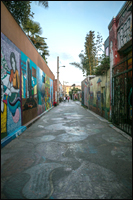

Barbara Mumby-Huerta, Clarion Alley, 2023, 2024, Current
OUR MATRIARCHS, Barbara Mumby-Huerta, acrylic, 12′ x 16.5′, Clarion Alley, San Francisco, CA
“Our Matriarchs” pays homage to 13 living Indigenous women who have made an indelible mark on the San Francisco Bay area and beyond.
The significance of the number thirteen is based upon personal tribal teachings and our responsibility to the number of generations in the past as well as those in the future we should honor and nurture. These women personify the leadership traits that we, as a community, need. They are: the healers of hearts; the keepers of dreams; the weavers of words; the sowers of seeds; the defenders of justice, and; the embodiment of warriors.
The largest challenge of this work was selecting only 13 women to honor, as there are so many amazing women that could have been included. To make this decision more manageable, I narrowed my criteria to living women older than myself. I felt a responsibility to honor the land where the mural sits by including an Ohlone leader, as well as including tribal representation from both sides of the colonial US/Mexican border and the Kingdom of Hawaii.
My work is grounded in the desire to uplift women who are often ignored or disregarded by western society. Predominately, this equates to mature women of color who push boundaries and challenge the status quo. By confronting the historically male defined idea of what beauty is, my portraits embrace the beauty that comes with wisdom and experience and honors the power our matriarchs possess.

The imagery includes:
Hummingbirds and butterflies, representative of the spirits of our ancestors.
Stylized Datura Flowers which are an important medicinal and ceremonial plant for California Indians
Manzanita branches that frame each portrait and intertwines with one another which honors the land and the family that nurtured my upbringing and signifies our connection to one another.
Flowing water which is traditionally kept and protected by Indigenous women.
Salmon, which represents renewal, sustenance, and the continuation of all life.
Featured Women:

Corrina Gould (Lisjan Ohlone) was born and raised in Oakland, CA, the village of Huichin and is the chair and spokesperson for the Confederated Villages of Lisjan. A mother of three and grandmother of four, Corrina is the Co-Director for The Sogorea Te’ Land Trust, a women-led organization within the urban setting of her ancestral territory of the Bay Area that works to return Indigenous land to Indigenous people, and the Co-Founder and Lead Organizer for Indian People Organizing for Change, a small Native run organization that works on Indigenous people issues and sponsored annual Shellmound Peace Walks from 2005 to 2009. These walks brought about education and awareness of the desecration of sacred sites in the greater Bay Area. As a tribal leader, she has continued to fight for the protection of the Shellmounds, uphold her nation’s inherent right to sovereignty, and stand in solidarity with her Indigenous relatives to protect our sacred waters, mountains, and lands all over the world.

Dr. Concepcion ‘Concha’ Saucedo Martinez (Yaqui, Mexica, Chicana) was born and raised in California in a traditional way. With her doctorate in psychology with an emphasis on clinical social interventions, she has attempted to integrate traditional Indigenous healing practices with western healing interventions. She is a grandmother of three, co-founder of Instituto Familiar de la Raza, Inc., as well as a teacher, professor, and community organizer for social justice for more than 50 years. At present her vocation is to pass on to others (particularly young people) healing practices and ceremonies from this continent.

Carolyn Kuali’i

Mary Travis Allen (Seneca)

Dr. LaNada WarJack (Shosone-Bannock) attended the University of California Berkeley and participated as the Native American leader of the Third World Strike to establish the first Ethnic Studies Program in the UC University system. In 1969, she and other students throughout California took over Alcatraz Island to protest the federal government’s ill treatment of Native people and broken treaties with tribes. LaNada was on the founding and executive board of the Native American Rights Fund, an elected councilwoman for her tribes, and has served on many boards both locally and nationally. Dr. WarJack completed her graduate work at Idaho State University with a master’s in public administration and a Doctorate of Arts Degree in Political Science. She has served as the Executive Director for the Shoshone-Bannock Tribes and is presently the President of Indigenous Visions Network. She is the author of “Native Resistance: An Intergenerational Fight for Survival and Life” which is available on her website www.drwarjack.com.

Alberta Snyder

L Frank Manriquez (Tongva and Ajachmem)

Bird Levy

Kim Shuck (Tsalgi) was born in San Francisco, California and is a member of the Cherokee Nation of Oklahoma. She received a BA in Art and an MFA in Textiles from San Francisco State University. Kim is the author of Deer Tails (City Lights Books, 2019), Clouds Running In (Taurean Horn Press, 2014), Rabbit Stories (Poetic Matrix Press, 2013), and Smuggling Cherokee (Greenfield Review Press, 2005), as well as of the chapbook collection Sidewalk Indian (Foothills Press, 2018). She is a Poet Laureate Emeritus of San Francisco, California.

Mary Jean Robertson

Debbie Santiago

Ruth Villasenor (Chiricahua Apache and Mexican) identifies as “Two-Spirit” and has been a member of the Bay Area American Indian Two Spirits (BAAITS) since 1998 and is a founding member of the BAAITS’ annual Two-Spirit Powwow. Ruth is a recipient of KQED’s 2003 Local Hero recognition for her community activism in the HIV field and bringing traditional Native America spiritual practices to patient’s wellness regimen. She is a 2008 graduate of the Queer Women of Color Media Arts Program (QWOCMAP) and produced “Traditional Indigenous Values,” an 8mm documentary reflecting on the historical acceptance of Two-Spirit people, the effects of colonization and Prop 8. In 2021, she co-curated “Calling Us Home/Regreasa” with Crystal Azul and Sam Campbell for SOMARTS’ Dia de los Muertos installation. She is a member of the curating team for the mixed media exhibition, “Two-Spirit Voices: Returning to the Circle,” at the GLBT Historical Society Museum celebrating the 20th anniversary of BAAITS.

Sara Moncado

An exploration of the expansionist ideology of Manifest Destiny, its continuing impact on multicultural communities in the San Francisco Bay Area and beyond, as well as its legacies of inherited and perpetuated violence, trauma, addiction, and the outgrowths of resistance and resilience to Manifest Differently
Manifest Differently is a multifaceted project featuring 38 multigenerational artists and poets. Using literary, visual, and media arts storytelling in conjunction with public programming, the collaboration will interrogate the expansionist ideology of Manifest Destiny, its continuing impact on multicultural communities in the San Francisco Bay Area and beyond, its legacies of inherited and perpetuated violence, trauma, and addiction, and the outgrowth of resistance and resilience – giving fire to movements for social change. As recognized in Argentina’s National Commission on the Disappearance of Persons in 1983, South Africa’s Truth and Reconciliation Commission in 1996, and others that have followed, we must acknowledge and witness the impacts of our history before we can move forward, otherwise the same injustices will be repeated, as we have seen most recently in the case of Israel’s genocidal treatment of Palestinians.
Storytelling is a powerful tool to help provide deep witness, compassion, and inspiration.
Manifest Differently was conceived and developed by poet/artist Kim Shuck and CAMP co-director/ artist / writer Megan Wilson and is co-curated by Shuck, Wilson, Trisha Lagaso Goldberg, Amy Berk, and Katayoun Bahrami with support from California historian Barbara Berglund Sokolov, CAMP communications director Veronica Torres, and humanities advisors Mary Jean Robertson, Kyoko Sato, Fuifuilupe Niumeitolu, Anita Chang, and David A.M Goldberg. Audiences were introduced to the history of Manifest Destiny and the forward vision to Manifest Differently through the lens of a diverse multigenerational team of artists and poets, whose histories and experiences include those of American Indian/Indigenous, Asian American, Pacific Islander, Black/African American, Hispanic/Latinx, Southwest Asian, and North African (SWANA), and white/European American descent.
The project was exhibited in 2023/24 in collaboration with the following presenting partners – Clarion Alley Mural Project (CAMP,) Yerba Buena Center for the Arts (YBCA), Artists’ Television Access (ATA), Minnesota Street Project (MSP), San Francisco Public Library, Book Castle, the Beat Museum, Book Castle, San Francisco State University, and Stanford University.
Participating poets, artists, and humanities scholars include:
Poets: Aileen Cassinetto, Avotcja, Clara Hsu, Dena Rod, E.K. Keith, Fuifuilupe Niumeitolu, Genny Lim, Josiah Luis Alderete, Kim Shuck, Lauren Ito, Linda Noel, Lourdes Figueroa, Mahnaz Badihian, Maw Shein Win, MK Chavez, Stephen Meadows, Tongo Eisen-Martin, Tureeda Mikell, Voulette Hattar
Visual and Media Artists: Adrian Arias, Afatasi, Amy Berk, Anita Chang, Barbara Mumby-Huerta, Biko Eisen-Martin, Carolyn Castaño, Chris Gazaleh, Katayoun Bahrami, Kim Shuck, l. frank manriquez, Marcel Pardo Ariza, Megan Wilson, Rene Yung, Shaghayegh Cyrous, Shonna Alexander, Vaimoana Niumeitolu, Victoria Canby
Humanities Scholars: Dr. Anita Chang, Dr. David A.M. Goldberg, Dr. Fuifuilupe Niumeitolu, Dr. Kyoko Sato, Mary Jean Robertson
About the Artist:

Barbara Mumby was born and raised in California’s rural Central Valley, where her family’s Native American heritage and work as migrant farmers greatly influenced her passion for social justice. The youngest of five children raised by a single mother, the arts became an integral part of her life and worked as a coping mechanism for the poverty and instability surrounding her.
Barbara considers herself a Narrative Shifter: using the arts to challenge inaccurate and outdated perceptions of Indigenous Peoples and other marginalized groups. She believes the arts to be a powerful and effective tool for survival and an instrument to unite communities and move public policy.
As a figurative oil painter, Barbara approaches each piece of work as an opportunity to tell a visual story; where the subject’s history is embedded, either overtly or subversively, into the fabric of the work. Each artwork embodies an interwoven record of the artist and subject’s interactions and inter-connectedness, pays homage to the stories that are often ignored and captures the beauty in those that are often denied admiration by mainstream society.
Drawn to historical photos of Indigenous Peoples from the turn of the 20th century, a selection of Barbara’s work captures the tension between traditional lifeways and the Industrial Age: the place where ‘past’ meets ‘future’ and sits in a dialectic contradiction and defiance with one another.
She is also inspired by the power of the feminine and challenges traditional perceptions while exploring its modern definitions. Barbara’s intention is to uplift self-identifying women who, in the face of adversity, speak truth to power.
For over 35 years, Barbara has been a practicing artist with work housed in private collections as well as at the University of California, Berkeley, and in public buildings in Merced County. Primarily a figurative artist, she is also captivated by the ability to manipulate materials into objects of beauty and power, and is skilled in working with clay, metal, wood, photography, and fabric. Her three-dimensional works often honor ancestral traditions and memory.
Barbara lives in the San Francisco Bay Area with her family and is of mixed heritage: her maternal line descends from the Patawomeck, Mattaponi, Pamunkey Nations and the numerous tribes that intermarried with the Mantooth, Pettus, Hughes, Croshaw, and West families of Virginia and Tennessee, whereas her paternal line includes KonKow and Spanish heritage.